
Reviewed · CITY WALKS IN VANCOUVER
Ancient Trees of Vancouver Walking Tour
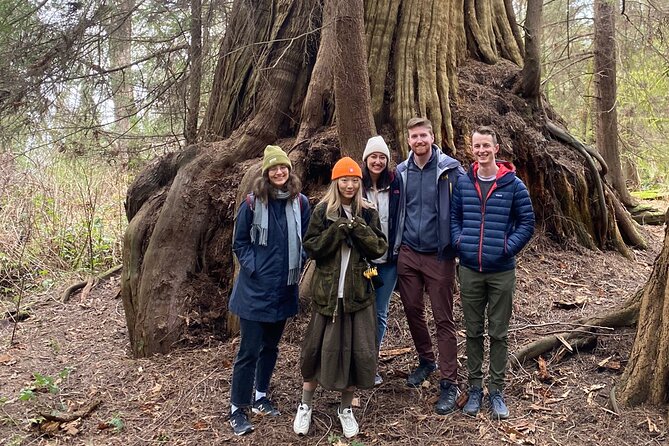
Stanley Park’s oldest giants change how you see trees. This Ancient Trees of Vancouver walk in Stanley Park is guided by Colin Spratt, a big-tree expert who uses old maps, photos, and postcards to connect the living forest to the people who shaped the area long before it became a park. I love how he ties forest ecology to Vancouver’s deeper roots, including the Coast Salish presence in this landscape.
I also like the max 10 participants setup, which keeps the pace relaxed and the stories easy to follow on gentle park trails. A possible drawback: there’s no pick-up or drop-off, so you’ll want to plan your own route to Ferguson Point and be comfortable with a steady 3-hour walk.
In This Review
- Quick hits on this Stanley Park tree walk
- Entering Stanley Park at Ferguson Point
- Why Colin Spratt makes the forest feel personal
- The “old growth” part: what you’ll actually notice on the trail
- The standout giants: cedars, firs, and that famous maple
- Old photos and postcards: history you can point at
- Ecology lessons that actually stick (nurse logs, hollowness, and more)
- What the 3-hour walk feels like in real time
- Morning vs afternoon: picking the right mood
- Value check: is $56.33 worth it?
- Who should book this tour, and who might skip it
- Practical tips before you go
- Should you book the Ancient Trees of Vancouver tour?
- FAQ
- How long is the Ancient Trees of Vancouver walking tour?
- Where is the meeting point?
- What’s the group size limit?
- What language is the tour offered in?
- Is pick-up or drop-off included?
- Is Stanley Park admission included?
- Do I receive a mobile ticket?
- Can I bring a service animal?
- What is the cancellation policy?
Quick hits on this Stanley Park tree walk
- Colin Spratt leads the tour, and he’s part of the BC Big Tree Committee
- Small group (max 10) means questions don’t get swallowed by a crowd
- You’ll track down standout giants like ancient Douglas firs, massive cedars, and Canada’s largest known maple
- The walk blends forest science + local history using old maps and archive postcards/photos
- The tour runs with morning and afternoon options for flexibility
Entering Stanley Park at Ferguson Point
If you’ve only experienced Stanley Park by bike, car window, or quick photo stops, this tour is a different way to feel the park. You start at Ferguson Point, 7501 Stanley Park Dr, and you return there at the end—simple, clear, and easy to plug into a day in Vancouver.
This matters because a walk like this works best when the meeting point is straightforward and the timing is predictable. Once you’re in the park, you’re not just looking at “pretty trees.” You’re learning how old-growth forests function and why they’re so rare in a big city.
Why Colin Spratt makes the forest feel personal
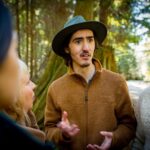
The big reason this tour gets consistently high marks is the guide. Colin Spratt doesn’t treat trees like background scenery. He turns them into characters, complete with age estimates, survival strategies, and the kinds of threats old forests face today.
One standout approach: he uses visuals from archives—old maps, photos, and 120-year-old postcards—to help you see how the same places have changed over time. When you can compare then-and-now, the trees stop being static objects. They become evidence of how ecosystems and human use have overlapped for generations.
Colin’s style is also built for real life. People talk about how he’s patient and able to keep kids interested (including families with children roughly ages 7–11). That’s a good sign if you want a tour that doesn’t talk down to anyone.
Vancouver gives up more on foot. Other walks
The “old growth” part: what you’ll actually notice on the trail
Old-growth forests are often described in big, vague terms. On this walk, you get specific things to look for, which makes the whole experience click.
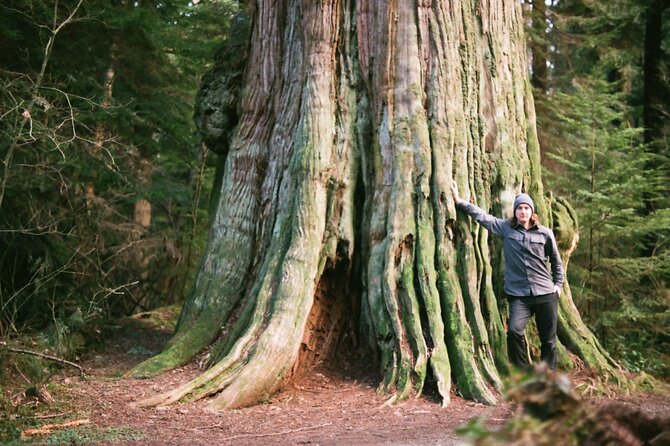
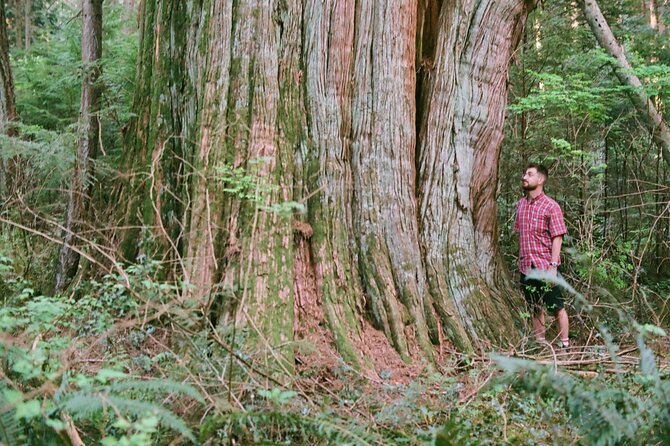
You’ll be shown impressive trees that can date back centuries—especially ancient western red cedars and towering Douglas firs. Depending on which individual trees you visit, you may hear age ranges around 600–800 years for firs and around 1,000 years for standout cedars (the tour’s descriptions emphasize very long lifespans for these giants).
And here’s what I think is the practical value: once you learn what to notice—growth form, branching patterns, and the “signals” older trees give—you start spotting the forest’s logic all by yourself. It’s not just a guided photo walk. You leave with a checklist for how to read a living system.
The standout giants: cedars, firs, and that famous maple
The tour’s core thrill is physical. You’re in Stanley Park, but you’re not stuck in “urban green space” mode. You’re aiming for trees that feel like they should have their own zip codes.
Expect to focus on:
- Ancient western red cedar trees, including extremely old specimens often described as around 1,000 years old
- Towering Douglas firs, highlighted as some of the city’s oldest examples, with ages noted around 600–800 years
- A stop that includes the largest known maple tree in all of Canada
If you like nature the way you like architecture—details, proportions, and craftsmanship—this is your kind of outing. The trees are big, but the storytelling is even bigger: Colin explains how old trees can be hollow, how they can house wildlife, and how they continue to support new life even after years of stress.
Old photos and postcards: history you can point at
This tour gives you a neat trick: it shows you history without forcing you into a museum. The walk uses old maps and archive postcards/photos to explain how the area has been viewed and used across time.
You also hear about the original Coast Salish inhabitants who lived in this area for thousands of years before it became an urban park. That context changes your experience fast. Instead of treating Stanley Park as a finished product, you start seeing it as a place layered with human memory and ecological change.
The practical upshot? You’ll understand why the park is shaped the way it is—and why conservation issues are still very real. Old-growth forests face pressures today, and this walk makes those threats feel specific rather than abstract.
This city was built for walking off a coffee

Ecology lessons that actually stick (nurse logs, hollowness, and more)
The best tours teach you one or two ideas you can keep using after you’re done. Here, the ideas are forest processes, not just facts.
A few of the ecology themes you’re likely to hear:
- How nurse logs work, where fallen wood helps new plants start
- Why many ancient trees become hollow, and how that can create habitat
- How cedar anatomy and life strategies connect to survival in a damp, changing environment
- Why slow growth and resilience are part of what makes old trees worth protecting
These topics matter because they change how you look at the “messy” parts of a forest. Fallen trunks and hollows stop looking like decay. They start looking like the architecture of regeneration.
What the 3-hour walk feels like in real time
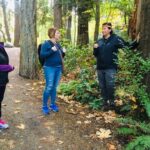
This is a 3-hour experience, guided and on foot. The pacing is built for comfort: the tour is kept small (up to 10 people), and the focus is on trails that are described as easy enough for most participants.
Still, it’s wise to plan it as a walking block, not a quick stroll. You’re there for the longer story arcs—tree identification moments plus history and ecology explanation—so comfortable shoes and weather layers are more than “nice to have.”
Also consider how you schedule it. If you’re visiting in peak season, keep in mind it’s often booked well ahead—on average around 46 days before the date—so don’t wait for perfect weather.
Morning vs afternoon: picking the right mood
You’ll usually see both morning and afternoon tours offered. That’s not just convenience; it can affect how you experience the forest.
If you like quieter atmosphere and lower city-energy vibes, morning can feel calmer. If you prefer sleep-in time and want your tour to sit between other sightseeing, afternoon works well. Either way, the structure stays the same: guided walking, tree stops, and the story built around them.
Value check: is $56.33 worth it?
At $56.33 per person for about 3 hours, you’re paying for more than access to Stanley Park. You’re paying for a guide who connects:
- individual ancient trees (with age and identification focus)
- ecology concepts that explain what you’re seeing
- local human history through archives and Coast Salish context
The value improves further because this isn’t a large crowd. A group capped at 10 means more time per person for questions and attention to details. And the tour notes that admission is free, so you’re not paying extra park-entry fees on top of the guide.
Where you might feel the cost more:
- If you mostly want broad “Stanley Park highlights” and minimal talking
- If you’re not that interested in tree identification or history
- If you’d rather bike or do self-guided stops without a fixed route
Who should book this tour, and who might skip it
This works best for you if you want one of these outcomes:
- You love trees and want to understand what makes old growth different
- You enjoy guided explanations that use real visuals like maps and postcards
- You want a break from typical city attractions and still get something educational
It’s also a strong choice for couples and solo travelers because the small-group format makes it feel personal, not like you’re herded from point to point. Families can be a good fit too; the guide’s approach is described as patient with kids who ask lots of questions.
If you’re the type who wants only the easiest possible walk with zero “learning moments,” you may find the structure a bit more instructional than you expected. For those folks, a general Stanley Park stroll might feel better.
Practical tips before you go
This tour is simple on paper, but it still helps to show up ready.
- Bring comfortable walking shoes for a 3-hour route
- Dress for rain and wind if that’s in the forecast
- Arrive a few minutes early so you can start without stress at Ferguson Point
- If you’re using a mobile ticket, have it accessible on your phone
- Since there’s no pick-up/drop-off, plan your transport to the meeting address ahead of time
Should you book the Ancient Trees of Vancouver tour?
Yes, if you want Stanley Park to feel like more than a postcard. This tour gives you ancient tree context, hands-on “how to look” skills, and a guide who brings the forest’s ecology and Vancouver history into the same story.
I’d skip it only if you’re mainly after quick views, you hate walking, or you don’t want explanations beyond what you can read from a signboard. For the right traveler, this is exactly the kind of time that changes how you see a place—especially once you notice the forest patterns on your way back to everyday city life.
FAQ
How long is the Ancient Trees of Vancouver walking tour?
It runs for about 3 hours.
Where is the meeting point?
The tour starts at Ferguson Point, 7501 Stanley Park Dr, Vancouver, BC V6G 3E2, Canada.
What’s the group size limit?
The tour has a maximum of 10 travelers.
What language is the tour offered in?
The tour is offered in English.
Is pick-up or drop-off included?
No. Pick-up and drop-off at the meeting point are not included.
Is Stanley Park admission included?
The experience notes that the admission ticket is free.
Do I receive a mobile ticket?
Yes, the tour includes a mobile ticket.
Can I bring a service animal?
Service animals are allowed.
What is the cancellation policy?
You can cancel for a full refund if you cancel at least 24 hours in advance. If you cancel less than 24 hours before the start time, the amount paid is not refunded.
Vancouver at Walking Pace
- Gastown Historic Walking Food Tour★ 5.0 · 1,863 reviews
- Vancouver Lost Souls of Gastown Walking Tour★ 5.0 · 1,273 reviews
- A Wok Around Chinatown: Culinary and Cultural Walking Tour Led by a Chef★ 5.0 · 610 reviews
- The Forbidden Downtown and Gastown Walking Tour★ 5.0 · 476 reviews
The Wider Vancouver Shelf
- Vancouver Half-Day Whale Watching Adventure with Free Photos★ 5.0 · 5,000 reviews
- Big Bus Vancouver Hop-On Hop-Off Sightseeing Tour★ 3.5 · 3,028 reviews
- Victoria & Butchart Gardens Tour with Ferry from Vancouver★ 4.5 · 2,703 reviews
- Vancouver: Covered Whale Watching Adventure with Free Photos★ 4.8 · 2,260 reviews
Sidewalk Miles in Vancouver
- Gastown Historic Walking Food Tour★ 5.0 · 1,863 reviews
- Vancouver Lost Souls of Gastown Walking Tour★ 5.0 · 1,273 reviews
- A Wok Around Chinatown: Culinary and Cultural Walking Tour Led by a Chef★ 5.0 · 610 reviews
- The Forbidden Downtown and Gastown Walking Tour★ 5.0 · 476 reviews
Just Reviewed in Vancouver
- Private Transfer from Vancouver Airport to Cruise Terminal (Port)
★ 5.0 · 3 reviews - Private Chauffeured Airport to Whistler Transfer (YVR – Whistler)
★ 3.5 · 3 reviews - Experience the Beauty of Vancouver’s Forests by Bike/E-Bike
★ 5.0 · 3 reviews - Banff, Moraine Lake, Lake Louise and Columbia Icefield 4 Day Tour
★ 4.5 · 3 reviews - Arrival Transfer: Vancouver Airport YVR – Vancouver by Luxury SUV
★ 5.0 · 3 reviews - Vancouver Waterfront Guided Bike/E-Bike Tour
★ 5.0 · 3 reviews
City Walks in Vancouver, compared.
 ★ 5.0Gastown Historic Walking Food TourFrom $1161,863 reviews
 ★ 5.0Vancouver Lost Souls of Gastown Walking TourFrom $291,273 reviews
 ★ 5.0A Wok Around Chinatown: Culinary and Cultural Walking Tour Led by a ChefFrom $122610 reviews
 ★ 5.0The Forbidden Downtown and Gastown Walking TourFrom $29476 reviews
 ★ 4.5Gratuity-Based Vancouver City Highlights 3 Hour Walking TourFrom $5320 reviews
 ★ 5.0Vancouver Secrets of Stanley Park Walking TourFrom $29208 reviews
 ★ 5.0Experience Gastown Vancouver’s Elite Walking Food TourFrom $80134 reviews
 ★ 4.1Private Walking Tour with a LocalFrom $43110 reviews
Browse the lists this tour appears in